

Risk Management · 2025
In this section2 topics
Risk Management Policy & Plan
Policy & Plan Description
AAPICO Hitech Public Company Limited (“The Company”) considers its risk management and risk assessment processes as a crucial part of our mission to drive sustainable growth of the organization. The Board of Directors has, therefore, formed the Board of Risk Management Committee to establish, supervise, and oversee the policy, and ensure that the Company’s internal control processes are in line with the quality management standards. The Board is responsible for determining the Company’s risk strategy and direction of the Company’s risk management system, as well as the Company’s risk appetite and risk tolerance level.
Moreover, the Risk Management Committee also evaluates and identifies the Company’s potential risk factors and assesses the likelihood of occurrence and financial impact of each risk category and determined an appropriate internal control to mitigate such risks to an acceptable level, in light of recent developments and changes in the business environment. The Risk Management policy may be found under the Investor Relations Section in the Company's website > Corporate Governance > Corporate Governance Policy.
The Company has assessed and identified the key risks to mitigate any impact and/or minimize likelihood, despite the nature of some risks that are beyond our control and could materially impact the Company’s operation, financial position, or reputation. The risk matrix shows the overview of key risk factors in 2025, which several items remained unchanged from the previous year, while some have been recently added.
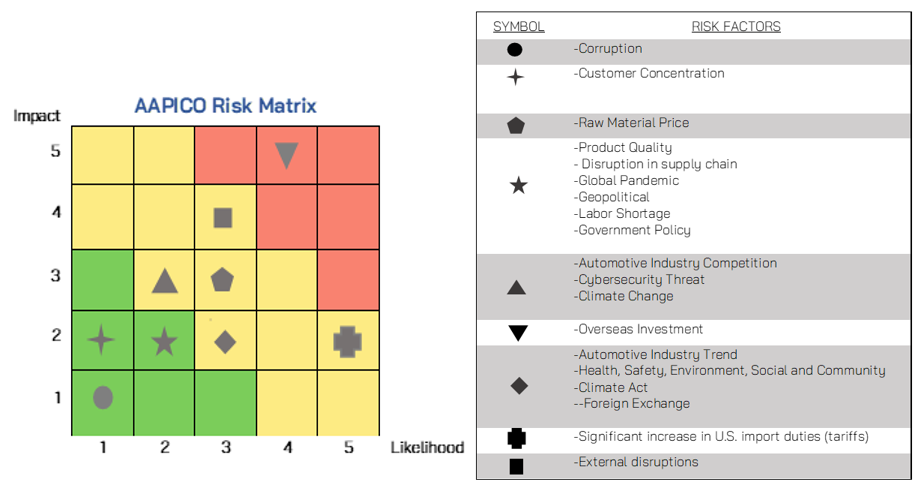
Risks in the red zone exceed tolerance level and must be actively managed.
Risks to the Company's Business Operations
Risk Register
| Risk Name | Risk Characteristics | Consequences | Management Measures | Related Risk Factors |
|---|---|---|---|---|
| Risk from Government Policies | Government policies, both domestic and international, influence demand in the automotive industry and may affect the Company’s revenue both directly and indirectly. In particular, investment promotion policies, economic stimulus measures, tax measures, and support for the electric vehicle industry, such as tax incentives, purchase subsidies, and environmental targets, play an important role in shaping market dynamics. Changes in these policies may affect the direction of demand for automobiles, automotive parts, and the long-term structure of automotive products. | Government measures that support investment and consumption could stimulate the production of automobiles and automotive parts, resulting in increased purchase orders for the Company. Conversely, the absence of supportive measures or the introduction of policies that negatively affect demand for automobiles could lead to a decline in purchase orders and affect the Company’s revenue. In addition, the transition from internal combustion engine vehicles to electric vehicles may increase demand for certain types of parts while reducing demand for others. This may affect the Company’s revenue structure and profitability in the future. | The Company closely monitors and assesses the impact of government policies and policies related to electric vehicles. Production planning, raw material management, and workforce allocation are adjusted in line with market trends during each period. At the same time, the Company continues to develop its capabilities in manufacturing, technology, and product development in order to enhance flexibility and adaptability under changing policy environments. | 730 · Description: Government policy · Info category: STRATEGIC_RISK |
| Risk from Overseas Investment | As part of its strategy to become a global company, the Company continues to expand its transactions and investments overseas. This expansion may expose the Company to risks arising from differences in legal and regulatory frameworks, business practices, and economic conditions across countries, as well as political uncertainties. In addition, operations through subsidiaries, associates, and joint ventures may give rise to risks related to differing policies, management approaches, and levels of operational control, which could impact the Company’s operational efficiency and financial performance. | Conflicts with business partners or operations of overseas subsidiaries, associated companies, and joint ventures that do not perform in line with plans may affect the Company’s operating results and profitability. This may also affect the value of investments, cash flows, and the Company’s reputation among shareholders, customers, and business partners. | The Board of Directors has established guidelines and criteria for careful consideration of investment decisions. Management is required to conduct feasibility studies for each project and to enter into clear agreements with partners that define the roles and responsibilities of each party. Significant investment must be approved by the Board of Directors in accordance with the criteria established. After the investment is made, the Company closely monitors operating performance. Executives of overseas subsidiaries and associated companies report operating results on a monthly basis and present annual business plans to management, while progress is reported to the Board of Directors every six months. In addition, investment risks are regularly assessed and reported to the Risk Management Committee. Appropriate criteria are also established for the consideration of investment impairment to ensure that investments generate appropriate returns and support the Company’s sustainable growth. | 728 · Description: Volatility in the industry in which the company operates · Info category: STRATEGIC_RISK · 730 · Description: Government policy · Info category: STRATEGIC_RISK · 731 · Description: Policies or international agreements related to business operations · Info category: STRATEGIC_RISK · 1715 · Description: Economic risk · Info category: STRATEGIC_RISK |
| Risk from Automotive Industry Competition | The automotive industry is highly competitive, particularly during periods of new vehicle model launches. Automotive parts manufacturers compete intensively to obtain purchase orders from automobile manufacturers, as such orders represent a source of revenue throughout the production life cycle of each vehicle model. Therefore, the Company faces the risk of losing purchase orders to other parts manufacturers if it is unable to compete effectively in terms of quality, cost, technology, or delivery performance. | Intense competition or the loss of purchase orders from key customers may have a significant impact on the Company’s revenue, operating results, and capacity utilization. In addition, it may affect the Company’s reputation and its opportunities to secure new projects in the future. | The Company maintains its position as a Tier 1 automotive parts manufacturer in Thailand, with efficient operational standards and a strong commitment to stakeholders. The Company places importance on maintaining strong relationships with customers while upholding high standards of product quality, on time delivery, and efficient cost management in order to build confidence and trust in securing purchase orders for new vehicle models on a continuous basis. Awards and recognitions received from customers in recent years also reflect the Company’s capabilities and strong operating track record. | 1714 · Description: Competition risk · Info category: STRATEGIC_RISK |
| Risk from Customer Concentration | The Company faces the risk of customer concentration, as the automotive industry in Thailand has a limited number of major automobile manufacturers. A significant portion of the Company’s revenue is derived from three key customers, namely Isuzu, Dana, and Auto Alliance Thailand Co., Ltd. (AAT), which account for approximately 20 percent, 7 percent, and 6 percent of total sales from automotive parts manufacturing business, respectively. As a result, the Company’s operating performance is closely linked to the business performance, production plans, and market share of these key customers. | If the Company loses purchase orders from any of its key customers, or if such customers reduce production capacity or lose market share, this may have a significant impact on the Company’s revenue, profit margins, and overall operating performance. | The Company has established plans to increase sales across all product groups while expanding its customer base to enhance diversification in both products and customer segments. The Company also continues to expand its market presence in both domestic and international markets in order to reduce dependence on any single customer. Over the past three years, the Company’s customer diversification structure has shown continuous improvement, which helps reduce the level of customer concentration risk and supports the stability of profit margins in the long term. | 734 · Description: Reliance on large customers or few customers · Info category: STRATEGIC_RISK |
| Risk from Changes in Automotive Industry Trend | This risk arises from structural changes in the automotive industry driven by technological advancements, government support policies, and rapidly evolving consumer behavior. In particular, the growth of electric vehicles, the increasing use of lightweight materials and advanced manufacturing technologies, as well as the wider adoption of digital systems, connectivity technologies, and autonomous driving technologies are reshaping the industry landscape. These developments may affect cost structures, competitive dynamics, and demand for certain types of automotive parts in the future. As a result, the Company’s competitiveness and long-term growth may be affected if it is unable to adapt to such changes in a timely and appropriate manner. | In the short term, the Company expects that these trends will not have a material impact on its operations, as many technologies remain in the early stages and require time for commercial development. With respect to the increasing demand for electric vehicles, the Company believes that the impact on its core revenue remains limited, as its main products, including pickup truck chassis frames and body parts, continue to be essential components for all types of vehicles, including battery electric vehicles, hybrid electric vehicles, plug in hybrid electric vehicles, and internal combustion engine vehicles. However, in the long term, if the Company is unable to develop technologies and products in line with industry developments, this may affect its competitiveness and sustainable growth. | The Company has established a research and development function to continuously monitor technological trends and assess their potential strategic impact, while supporting product development in line with industry developments. At the same time, the Company continues to strengthen its core businesses, including automotive parts manufacturing and automobile dealership and service center operations. In addition, the Company is developing technology and connectivity related businesses to capture new business opportunities and enhance its competitiveness in the long term. | 728 · Description: Volatility in the industry in which the company operates · Info category: STRATEGIC_RISK · 732 · Description: Changes in technologies · Info category: STRATEGIC_RISK |
| Supply Chain Disruption | The automotive industry has a highly complex supply chain and relies significantly on specialized component manufacturers. In many cases, critical components are sourced from a single supplier (Single Source Supplier). If such suppliers are unable to deliver components as scheduled, it may result in disruptions to the production process, preventing vehicle assembly from continuing as planned. | Various factors such as pandemics, natural disasters, or geopolitical tensions may disrupt supply chains and affect both domestic and international production and logistics activities. Shortages of certain components or raw materials may prevent production from proceeding according to plan, which could affect the Company’s revenue, cost structure, and ability to deliver products to customers on schedule. | The Company closely and continuously monitors global developments in order to assess potential risks and establish appropriate management plans. The Company also works closely with stakeholders across the supply chain while improving operational strategies and processes to enhance efficiency. These measures include diversifying sources of raw materials by engaging multiple suppliers, considering the use of domestically sourced materials as substitutes for imported materials, and closely managing inventory levels. Such actions help enhance operational flexibility and reduce the impact of potential supply chain disruptions in the future. | 733 · Description: Business operations of partners in the supply chain · Info category: STRATEGIC_RISK |
| Changes in U.S. Trade Policies and Import Duties (Tariffs) | Changes in the trade policies of the United States, including the imposition or increase of import tariffs on automotive parts manufactured in Thailand, may arise from geopolitical tensions, trade protection policies, or changes in international trade relations. Such measures may increase product costs and affect price competitiveness in the United States market. | At present, the impact on the Group remains low, as the proportion of direct exports from Thailand to the United States is limited. However, following the establishment of a holding company and a joint venture in the United States in 2025, with the construction of a new manufacturing facility commencing in December 2025, the Group may have exposure to import tariffs related to the shipment of molds, tools, and certain components from overseas to the United States during the pre-production phase over the next 2–3 years. The Company continues to closely monitor and assess the situation in order to effectively manage any potential impacts at an appropriate level. | The Company closely monitors developments and changes in United States trade policies and import tariffs while continuously assessing potential impacts on its operations. The Company also considers appropriate risk mitigation measures, including adjustments to the supply chain structure, increasing the proportion of local production, and coordinating with customers and professional advisors in order to effectively manage tariff-related risks and support the sustainable long-term growth of the business. | 731 · Description: Policies or international agreements related to business operations · Info category: STRATEGIC_RISK |
| Risk from Raw Material Price Fluctuation | Steel is the primary raw material used in the production of automotive parts and represents a significant proportion of the Company’s production costs. As a result, the Company is exposed to the risk of fluctuations in global steel prices. Such volatility may arise from various factors, including supply and demand conditions, energy prices, economic conditions, and geopolitical developments. These fluctuations may significantly affect the Company’s cost structure. | Changes in steel prices may directly affect the Company’s profit margins, as steel accounts for approximately 70 percent of the cost of goods sold. If raw material prices increase rapidly and the Company is unable to adjust selling prices in a timely manner, this may affect the Company’s operating results and cash flow. | The Company mitigates this risk through a centralized purchasing policy. Under this approach, the Company enters into arrangements with customers to procure steel from approved suppliers at mutually agreed prices. In addition, pricing mechanisms are established to allow adjustments to selling prices in line with changes in steel prices. | 740 · Description: Shortage or fluctuation in pricing of raw materials or productive resources · Info category: OPERATIONAL_RISK |
| Risk from Labor Shortage | A shortage of skilled labor, as well as issues related to labor unions, may affect the Company’s production capability and its ability to deliver products to customers. This is particularly relevant in the automotive industry, where production processes require skilled workers and operational continuity. If human resources are not managed effectively, this may create risks to the Company’s operational efficiency. | Such risks may lead to disruptions in production lines, delays in product delivery, and increased operating costs. In addition, these issues may affect the Company’s credibility and could also have broader implications for the stability of the automotive manufacturing industry. | The Company recognizes employees as a key resource of the organization and therefore supports employee well-being, compensation, welfare, and continuous development of capability. The Company also manages its relationship with labor unions in a careful and appropriate manner in order to reduce the likelihood of labor disputes. In addition, the Company plans to implement automation systems and smart technologies in its production processes to reduce reliance on manual labor and enhance production efficiency in the long term. | 739 · Description: Shortage or reliance on skilled workers · Info category: OPERATIONAL_RISK |
| Risk from Product Quality Issues | Product quality risks may arise from deviations in production processes, machinery malfunctions, defects in raw materials, insufficient quality control, or human error. These factors may result in product defects or failure to meet technical specifications or customer defined standards. In addition, the increasing complexity of automotive components and stringent safety requirements may further increase the risk of quality issues if control processes are not sufficiently rigorous. | If product quality issues occur, the Company may incur related costs such as warranty claims, rework expenses, contractual penalties, or costs associated with product recalls. These factors may affect the Company’s operating results and cash flows. In addition, such incidents may affect customer confidence and business relationships, as well as the Company’s reputation in the long term, and may reduce opportunities to secure new orders in the future. | The Company places strong emphasis on maintaining high production standards and delivering quality products to customers. Operations are conducted in accordance with the IATF 16949 quality management standard, and the Company has established a target of achieving zero defect delivery to customers. The Company also promotes a strong quality culture within the organization through awareness programs, training, and employee participation at all levels to ensure continuous improvement in quality control processes. In addition, the Company establishes provisions for defective product-related expenses in accordance with contractual terms and maintains product recall insurance coverage to mitigate potential financial impacts arising from such quality-related risks. | 741 · Description: Systems or internal control system · Info category: OPERATIONAL_RISK · 742 · Description: Human error in business operations · Info category: OPERATIONAL_RISK |
| Risk from Cybersecurity Threat | In today’s digital environment, information technology plays an increasingly important role in the Company’s business operations, including data management, production systems, and communication with customers and business partners. The adoption of digital technologies helps improve operational efficiency and supports the development of more effective business processes. However, such technological advancements also expose the Company to cybersecurity risks. These risks may arise from various forms of cyber threats, including cyberattacks, unauthorized access to information systems, malware, and ransomware attacks. Such threats may affect the confidentiality, integrity, and availability of the Company’s information and information systems, which could potentially disrupt business operations and affect the overall stability of the Company’s information technology infrastructure. | If a cybersecurity incident were to occur, the Company may face both financial and operational impacts. These may include disruptions to critical information systems, loss or leakage of sensitive information, and additional expenses related to system restoration, investigation, and remediation of the incident. In addition, cybersecurity incidents may damage the Company’s reputation and weaken the confidence of customers, business partners, and other stakeholders. Such impacts may adversely affect the Company’s competitiveness, and long-term sustainability. | The Company has implemented measures to strengthen its cybersecurity management in accordance with the NIST Cybersecurity Framework 2.0 and has established comprehensive policies and procedures relating to information security management. A Cybersecurity Committee has been established to oversee cybersecurity governance and regularly assess and monitor cybersecurity risks. The Company has also established a Security Operations Center (SOC) to continuously monitor information systems and respond promptly to potential cyber threats and incidents on a 24-hour basis. Furthermore, cybersecurity assessments, monitoring results, and recommendations are regularly reported to senior management in order to support strategic decision-making and enhance the Company’s ability to effectively manage cybersecurity risks. Through these measures, the Company aims to strengthen the resilience and security of its information systems while supporting the stability and sustainability of its business operations in the evolving digital environment. | 744 · Description: Information security and cyber-attack · Info category: OPERATIONAL_RISK · 1720 · Description: System disruption risk · Info category: OPERATIONAL_RISK |
| Risk from Global Pandemic | The Company recognizes the risk arising from global pandemics, which represent external factors beyond the Company’s control and cannot be predicted in advance. Such events may have widespread impacts on public health systems, government regulatory measures, workforce availability, supply chains, and overall economic activities. These circumstances may affect the continuity of production, the delivery of products, and the Company’s overall business operations. | A pandemic may cause disruptions to production processes and logistics, as well as constraints related to labor availability or raw material supply, which may result in increased operating costs. In addition, such circumstances may adversely affect market demand, liquidity, and the Company’s operating result, as well as its overall financial position. The severity and duration of such impacts depend on the scale of the outbreak and the control measures implemented by each country. | The Company has implemented risk management measures under its enterprise risk management framework, including the Business Continuity Plan (BCP) and the crisis management framework. These measures encompass the establishment of occupational health and safety practices, employee health monitoring, flexible working arrangements, emergency preparedness planning, and supply chain risk management. In addition, the Company closely monitors public health development and government measures and regularly reviews its preparedness plans in order to mitigate potential impacts and maintain business continuity effectively. | 1718 · Description: Pandemic risk · Info category: STRATEGIC_RISK |
| Risks from External Events Affecting Business Operations | The Company recognizes the potential risks arising from external events that occur infrequently and are difficult to predict in advance. Such events are typically caused by factors beyond the Company’s control and are difficult to prevent, including natural disasters, political unrest, disruptions of public utilities, or infrastructure failures. These events may significantly affect normal operations, the continuity of production processes, and the stability of the Company’s supply chain. | External events may lead to disruptions in production and product deliveries, delays in shipment, increased operating costs, or the loss of business opportunities. For example, a widespread power outage in Portugal in April 2025 caused the Group to temporarily suspend part of its production for approximately three weeks, which had a significant impact on its operating performance. | The Company seeks to strengthen its resilience and ability to recover from unexpected events by regularly developing and reviewing its Business Continuity Plan (BCP) and crisis management framework. The Company has also established contingency measures, emergency response plans, and operational recovery plans to mitigate potential impacts and ensure the effective continuity of the Group’s business operations. In addition, the Company purchase Business interruption insurance to mitigate the risk. | 755 · Other name: External events beyond the Company’s control impacting operations · Description: Other · Info category: OPERATIONAL_RISK |
| Foreign Exchange Risk | The Company is exposed to foreign exchange risk due to fluctuations in foreign currency exchange rates, as it generates certain export revenues and incurs some expenses in foreign currencies, as well as having investments and operations through overseas subsidiaries. However, such risk is considered to be at a low level, as direct export revenue accounts for less than 5% of total revenue and most transactions are conducted in Thai Baht. In addition, exchange rate fluctuations may affect the translation of the financial statements of overseas subsidiaries for the preparation of the Company’s consolidated financial statements. | Fluctuations in exchange rates may result in uncertainty in revenues and expenses denominated in foreign currencies when translated into Thai Baht. This may affect the Group’s operating results and financial position, and could also lead to foreign exchange gains or losses in the consolidated financial statements. | The Company manages foreign exchange risk by applying a natural hedging strategy, whereby revenues and expenses are matched in the same currency to the greatest extent possible. If such measures are insufficient to mitigate the risk, the Company may consider the prudent use of financial instruments, such as forward contracts or options, to manage foreign exchange risk. The Company does not engage in derivative transactions for speculative purposes and focuses on prudent financial risk management that is appropriate to the level of business risk. | 764 · Description: Fluctuation in exchange rates, interest rates, or the inflation rate · Info category: FINANCIAL_RISK |
| Health, Safety and Social Community Risk | The Company’s business operations may be exposed to risks related to employee health and safety, environmental impacts, and potential effects on surrounding communities. These risks may arise from production processes, the use of machinery, raw materials, energy, and other resources. If not properly managed, such activities may result in workplace accidents, the release of waste or pollutants exceeding regulatory standards, or complaints from nearby communities. These situations may affect the Company’s operations as well as its corporate image. | Such risks may lead to workplace accidents, employee injuries, damage to property, and disruptions to production operations. In addition, the Company may face legal liabilities, penalties, or costs associated with environmental remediation. These incidents may also undermine the confidence of stakeholders, local communities, and regulatory authorities, potentially affecting the Company’s reputation and long-term sustainability. | The Company has established occupational health, safety, and environmental policies and practices in compliance with applicable laws and regulations. It also promotes a strong safety culture through various initiatives, including Safety Week, CCCF activities, 5S activities, the White Factory Program, planned machinery maintenance, and annual health check-ups for employees. In addition, the Company implements initiatives to reduce energy consumption and resource usage, such as the adoption of solar energy and LED lighting in its factories. The Company has also obtained ISO 14001 certification, reflecting its commitment to systematic and continuous environmental and safety management. | 749 · Description: Safety, occupational health, and working environment · Info category: OPERATIONAL_RISK · 1717 · Description: ESG risk · Info category: STRATEGIC_RISK |
| Corruption Risk | Corruption, bribery, and a lack of transparency in business practices may arise in various operational processes, including sales, procurement, contracting, charitable donations, the giving or receiving of gifts and hospitality, as well as interactions with business partners and government agencies. Such risks may occur due to inadequate oversight or failure to comply with established policies and procedures. | Corruption may have a significant adverse impact on the Company’s operating results, financial position, and reputation. It may also expose the Company to legal liabilities, penalties, or sanctions imposed by regulatory authorities. Furthermore, such incidents may undermine the confidence of shareholders, customers, business partners, and other stakeholders, which could affect the Company’s competitiveness and long-term sustainability. | The Company is committed to conducting its business with integrity, honesty, and fairness. An anti-corruption policy has been established to serve as a guideline for all business units, and operational procedures are regularly reviewed with annual internal audits conducted to ensure compliance. In addition, the Company has implemented a Whistleblowing Policy that enables employees and stakeholders to report suspected misconduct or potential corruption directly to the Audit Committee. The Company has also been certified as a member of the Private Sector Collective Action Against Corruption (CAC) of Thailand for the period from June 2023 to June 2026, with the certification subject to renewal every three years. This reflects the Company’s concrete and ongoing commitment to preventing and combating corruption. | 754 · Description: Corruption · Info category: OPERATIONAL_RISK |
| Climate Change Risk | In recent years, climate change has increased the frequency and severity of natural events such as floods, severe storms, droughts, and water scarcity. These events may affect the Company’s facilities, supply chain, and infrastructure related to its business operations. Such risks represent external factors beyond the Company’s control and may create uncertainties for business operations in both the short and long term. | Climate-related disasters may disrupt production processes, cause damage to assets, or create constraints on critical resources such as water and energy. In addition, they may affect the ability of suppliers to deliver raw materials, which could result in lost revenue or increased costs associated with recovery and remediation. | The Company continuously monitors and assesses the potential impacts of climate change and regularly develops and reviews its Business Continuity Plan to prepare for possible disruptions. In addition, the Company has implemented a water management plan, which includes monitoring water levels and establishing flood prevention measures to reduce risks associated with extreme weather events. The Company also prepares necessary resources and other response measures to ensure that business operations can continue effectively even under unavoidable circumstances. | 750 · Description: Climate change and disasters · Info category: OPERATIONAL_RISK |
| Risk from Climate Act Regulations Affecting the Business | Amid the increasingly severe global climate change crisis, many countries have introduced more stringent environmental measures and regulations, such as greenhouse gas emission reduction targets, carbon taxation mechanisms, and policies promoting clean energy. These developments may have significant implications for the automotive industry, which is recognized as one of the sectors with relatively high greenhouse gas emissions. Such risks include the potential inability to comply with evolving environmental requirements, changes in regulations in international markets, and increasing pressure from customers, investors, and other stakeholders who place greater emphasis on sustainable business practices. | If the Company is unable to adapt to or comply with such requirements, it may face financial risks, including regulatory penalties, higher carbon tax obligations, or increased operating costs associated with improving production processes. In addition, non-compliance may adversely affect the Company’s reputation and the confidence of customers, investors, and business partners. It may also lead to trade restrictions in certain markets and potential legal risks, which could affect the Company’s competitiveness and long-term business opportunities. | The Company has established strategic initiatives to reduce greenhouse gas emissions and to enhance operational processes in alignment with environmental requirements. These initiatives include investments in clean energy, such as the installation of solar power systems, and the adoption of technologies to improve energy efficiency in production processes. The Company also promotes innovation aimed at reducing waste and improving resource efficiency. In addition, the Company places importance on the transparent collection and reporting of environmental data in accordance with internationally recognized standards, while strengthening collaboration with supply chain partners to reduce greenhouse gas emissions throughout the value chain. These initiatives not only help mitigate potential risks but also create competitive opportunities and strengthen the Company’s long-term business resilience and sustainability. | 756 · Description: Change in laws and regulations · Info category: COMPLIANCE_RISK |
| Geopolitical Risk | Political developments and international relations are important factors that influence investment, economic growth, operating costs, and the stability of global supply chains. Rising geopolitical tensions may lead to changes in trade policies, the imposition of sanctions, military conflicts, or other forms of instability. These external factors are beyond the Company’s control and may affect energy prices, transportation routes, and global supply chain dynamics. During 2024–2025, geopolitical risks remained highly uncertain, including the conflict between Russia and Ukraine, tensions in the Middle East affecting maritime shipping routes, as well as ongoing trade tensions between the United States and China and the growing trend of trade protectionism. Such developments may alter global trade structures and international investment flows. | Geopolitical risks may lead to higher costs for raw materials, energy, and transportation, as well as delays in product deliveries or disruptions in supply chains. In addition, such uncertainties may contribute to volatility in exchange rates, inflationary pressures, and declining market confidence, potentially delaying or reducing investment decisions. These factors could adversely affect the Company’s operating performance and its business expansion plans. | The Company closely and continuously monitors geopolitical developments, particularly policies and changes that may affect its operations both domestically and internationally. With operations across multiple countries in Europe and Asia, the Company conducts regular monthly monitoring meetings, during which representatives from each country provide updates on the latest developments, assess potential impacts, and formulate appropriate response plans. In the event of significant developments or heightened volatility, the Company will increase the frequency of monitoring and reporting as appropriate to ensure timely response and enhance business resilience under changing conditions. | 737 · Other name: Geopolitical tensions and changes in international relations · Description: Other · Info category: STRATEGIC_RISK |